
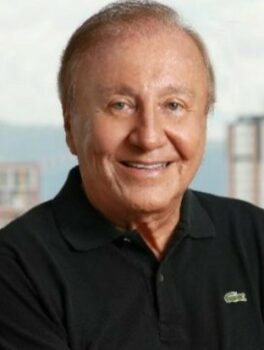
Two men. Both running to be the next president of Colombia. Both swear they are tough, that they are clean, that they are the answer to a country that is exhausted. And both of them have a problem with the company they keep.
One is a defense lawyer who built his career representing mobsters, paramilitaries, and at least one alleged front man for the Maduro regime — and he tells you those relationships were strictly professional. The other fought to spring a FARC commander out of a maximum-security holding cell — and he tells you that relationship was strictly professional too. One says, in effect, “I only knew the narco because I was his attorney.” The other says, “I only knew the guerrilla because I was a peace negotiator.” Same sentence, opposite ends of the political spectrum. It is the strangest mirror in Colombian politics.
This Sunday, June 21, Colombians return to the polls for the runoff. In the first round on May 31, the right’s Abelardo de la Espriella came first with about 43.7 percent. The left’s Iván Cepeda came second with about 40.9 percent. No one else is left. Whoever wins walks into the Casa de Nariño on August 7.
What follows is an analysis, not an endorsement. I am pro-business, anti-crime, and anti-communist, and I am not Colombian, so I will not presume to tell Colombians how to vote. What I can do is lay out who these two men are, where they came from, and the honest pros and cons of each — because both carry serious problems, and readers with capital, operations, or ties in Colombia deserve them laid out straight. Much of the biographical reporting here draws on the long-form profiles published by La Silla Vacía, among the best political journalism in the country, and on Finance Colombia‘s own coverage of the race.
Who is Abelardo de la Espriella?
Start with de la Espriella, since he holds a slight polling lead. His campaign events are not subtle: the lights go yellow, blue, and red, footage of tigers plays on the screens, smoke machines fire, the national anthem swells, and out he comes flanked by bodyguards in a bulletproof vest, declaring, “Here is your tiger, roaring and biting.” The tiger is his symbol — claw, territory, attack — and the crowd chant is ponle la raya al tigre, “put the stripe on the tiger.” It is a show, and he runs it the same way every time, with discipline.
According to La Silla Vacía’s profile, Abelardo was born in Bogotá in 1978 and grew up in Sahagún and Montería, in Córdoba on the Caribbean side. His mother calls the family riquitos de pueblo — “small-town rich.” A respected name and political connections, but not the rosca, the Bogotá elite, and not one of the great national fortunes. His father was a Liberal Party congressman and an early backer of Álvaro Uribe in Córdoba in 2001; when Uribe reached the presidency, he made the elder De la Espriella a notary. That is where the long relationship between the De la Espriella and Uribe families begins.
From childhood, Abelardo wanted to be seen. By his family’s account he sang opera in the bathroom, had a children’s radio program his father arranged, got himself onto regional television as a teenager, and promised his grandmother a limousine in Miami. He studied law at the Sergio Arboleda University in Bogotá — not an academic powerhouse, but a real breeding ground for the Colombian right — and hustled the whole way through, selling whiskey, perfume, clothing, and emeralds on consignment. The man has always been building a legend about himself.
Here is the part he does not lead with on stage. De la Espriella made his name as a defense lawyer, and not for choirboys. His client list reads like a rogues’ gallery: politicians tied to paramilitary groups, the Nule brothers of the carrusel de contratos contracting scandal in Bogotá, the pyramid-scheme operator David Murcia of DMG, the disgraced Constitutional Court magistrate Jorge Pretelt, and — the big one — Álex Saab, the man the United States accused of being a front man for Nicolás Maduro. Early in his career, at 26, he did legal and public-relations work around the paramilitary demobilization at Santa Fe de Ralito through an NGO he ran. His childhood friend from Córdoba is Salvatore Mancuso, the paramilitary chief.
He will tell you — and it is a legitimate argument — that every defendant has a right to counsel, and that defending an unpopular client is not the same as committing the client’s crimes. Fair enough. We will return to it.
After the lawyering came the brand. He launched a rum called Ron Defensor, “the Defender,” with the vallenato star Silvestre Dangond. He launched a clothing line, released music, wrote books, went through an atheist phase, and then, roughly six years ago, underwent a very public religious conversion. Now he is the “God and family” candidate who calls himself “the Cyrus of Colombia.” By his own design he is a sybarite: Italian suits every year, a Miami mansion valued north of $5 million USD, a private plane, the whole production.
Three facts to keep in your carriel for later. First, he has never held elected office; he ran for a Bogotá council seat as a student in the 1990s, lost, and stayed out of electoral politics for nearly thirty years. Second, he holds three citizenships — American, Italian, and Colombian. Third, his running mate is José Manuel Restrepo, a name that returns in a big way when we reach the pros.
“The ‘tough on crime’ candidate has spent his career defending criminals, and the ‘human rights’ candidate stays silent on half the human rights abuses in his own backyard.” — Loren Moss, Finance Colombia
Who is Iván Cepeda?
If de la Espriella’s story is about a man who wanted to be seen, Cepeda’s is about a man shaped by a death.
On August 9, 1994, a young Iván Cepeda took a bus to Javeriana University, where he taught philosophy, after letting his father leave the house first. On the way he came upon ambulances, police cars, and a crowd around a bullet-riddled car. It was his father’s car. Manuel Cepeda, a senator for the Unión Patriótica, had just been assassinated.
The detail that explains Iván Cepeda is what he did next. He did not collapse over the body. He pulled from his jacket a column his father had written about another murdered activist, crossed the street to tell his wife, and then turned and spoke to journalists — composed, on message, calling on the president and the courts to act. “When my father was murdered,” he later said, “I already knew how I should act, what I should say.” He turned private grief into public, political language. La Silla Vacía describes his entire method of politics as organized around the truth of the victims, and that is exactly right.
Cepeda was born in 1962, while his father was in prison for interviewing a survivor of the army’s bombing of Marquetalia, the peasant enclave that became the founding myth of the FARC. His parents, Manuel Cepeda and Yira Castro, were journalists, communists, and revolutionaries; politics was the air the household breathed. At 13 he was in the Communist Youth. At 17, after his mother’s death, his father sent him to study philosophy in Sofia, Bulgaria. He returned in 1987, by his own account disillusioned with Soviet Marxism and the privilege he had seen inside the party there.
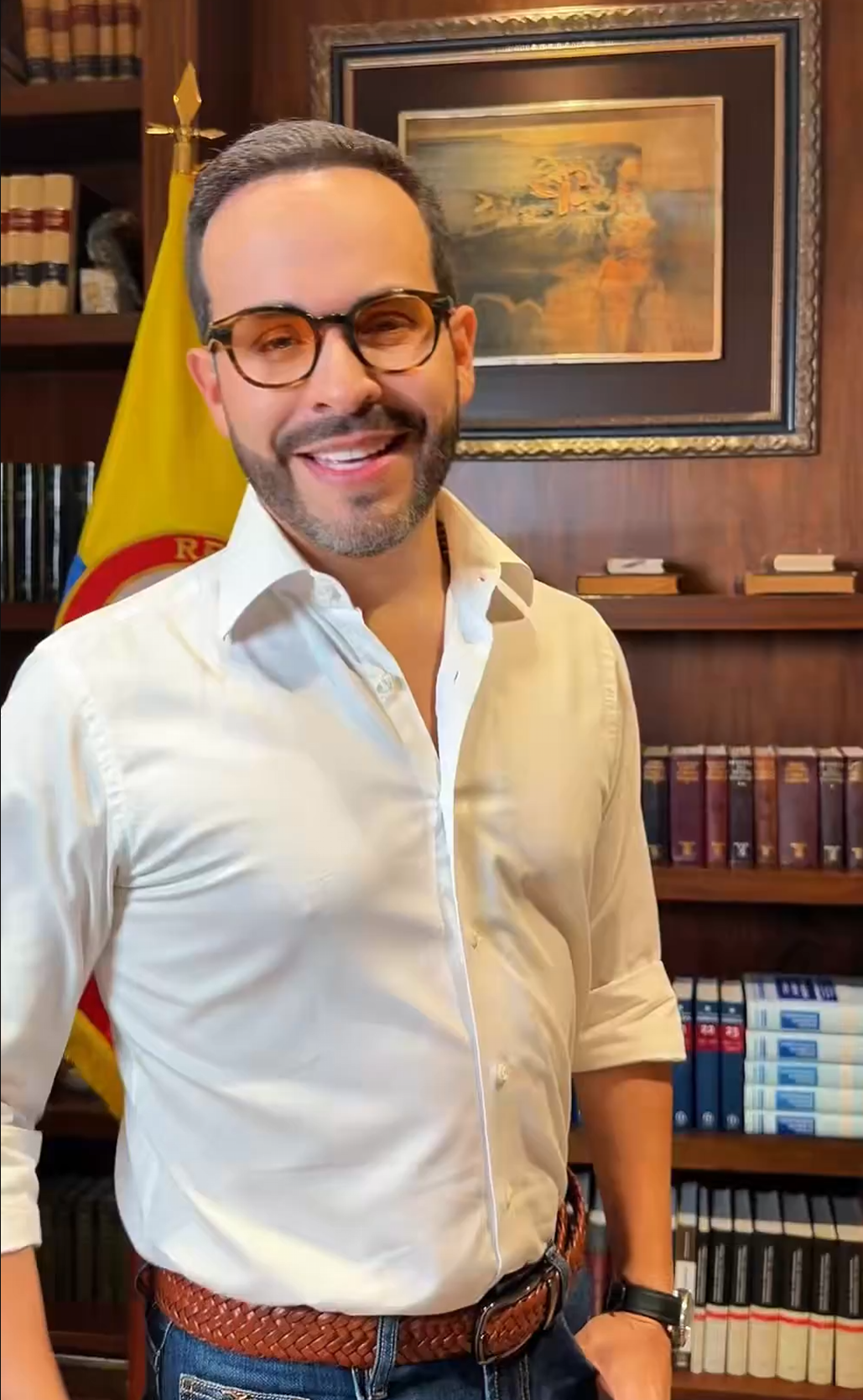
Abelardo de la Espriella is a millionaire defense attorney, singer & rum impresario. (photo: Twitter screencapture)
His father’s assassination was the turning point. The Unión Patriótica — a party born of a peace process, a vehicle for the FARC and the Communist Party to enter electoral politics — was then systematically exterminated, with thousands of members killed. Cepeda channeled all of it. He created the Manuel Cepeda Foundation, built memorial galleries with families of the disappeared, and founded MOVICE, the Movement of Victims of State Crimes. He pursued his father’s case until the Colombian state was held responsible and the Inter-American Court of Human Rights condemned the country.
Then he found his great adversary: Álvaro Uribe. For Cepeda, Uribe symbolizes the establishment he believes must confess its responsibility for paramilitarism and the killing of the left. He spent years pursuing Uribe — prison visits to extradited paramilitaries in the United States, the 2014 debate in Congress — and that work ultimately produced the witness-tampering case that put the former president on trial. Cepeda became, as La Silla Vacía puts it, the leftist who managed to put Uribe in the dock. That is the engine of his political career.
He reached Congress in 2010, famously arriving with a bucket, broom, and mop, promising to clean up a legislature stained by parapolítica — the scandal of lawmakers who colluded with paramilitary groups. He has been there ever since, four terms, mostly on the Second Committee, which handles military promotions, security, and foreign relations. The crucial point about his experience, and I will come back to it, is that he has never governed anything — no city, department, ministry, or large budget. His arena has been Congress as a moral and judicial forum. He was also the principal intellectual architect of Petro’s Paz Total, “Total Peace”; he coined the term.
His running mate is Aida Quilcué, an indigenous Nasa leader and senator who is herself a victim of state violence — her husband was killed by the military as they returned from a minga. One more thing matters because it is human and real: Cepeda is in fragile health. He has beaten cancer twice — colon cancer in 2018, liver cancer treated in 2022 — and people who have worked with him describe a worn body and an iron will. He is intellectually serious, sober, and predictable, the opposite of Petro’s chaos. Whatever you make of his politics, he is no lightweight.
The case for Abelardo de la Espriella
Let me make the genuine case for de la Espriella, as I see it.
He promises to be tough on crime — on the organized armed groups and on ordinary street crime alike. After four years in which armed groups roughly doubled in size under Total Peace, many Colombians are hungry for exactly that, and I understand why. He is pro-business and pro-investment, foreign and domestic, and he has built his whole pitch on the idea that prosperity comes from the private sector rather than the state. He is pro-US and promises to repair the relationship with Washington that frayed under Petro; he is, in fact, a US citizen himself, which tells you which direction he faces.
On the economy, I think he would restore investor confidence and likely work to repair Colombia’s diminished credit rating, which matters enormously for what the country pays to borrow. He supports lower taxes, which is a good thing when paired with genuine fiscal prudence — that is the caveat, but the instinct is right.
The strongest item on his ticket, for me, is his running mate, José Manuel Restrepo. Restrepo served as both Minister of Commerce and Finance Minister in Iván Duque’s cabinet and did the job well, even when Duque did not. He has few critics and brings a level of intellectual seriousness and economic credibility that the top of the ticket does not project on its own. A credible technocrat one heartbeat from the presidency is a real asset.
He wants to shrink the bureaucracy. Colombia’s is not as bloated as some in Latin America, but it can be streamlined — and the bigger problem than handing out sinecures is mermelada, the practice of spreading money through useless government contracts to friends and supporters. If he genuinely goes after that, good. He is also plainly intelligent; a successful defense attorney knows jurisprudence and procedure cold.
Two of his ideas deserve particular credit. He says he wants to promote home ownership for people of modest means, and El País reports a plan for below-market thirty-year mortgages. If that is real and it works, it is a genuinely good idea. The Peruvian author Hernando de Soto, in The Mystery of Capital, explains how broad asset ownership by ordinary people is what formalizes an economy and drives real progress: when you own assets, you can extract value from them, pass them to your descendants, and build lasting wealth. And on health care, he promises to fix the EPS system with financial oversight to root out corruption, rather than blow it up. That is far better than moving to a single-payer government scheme, which I think would be disastrous. The state has not shown the organizational competence to run one. Consider that Petro placed Daniel Quintero, the indicted former mayor of Medellín, in a role overseeing the EPS — and Quintero is accused of looting the city’s coffers. A couple of insolvent EPS providers is a manageable problem; a national government that cannot pay providers and collapses the whole system is not. Patching beats nationalizing.
He supports performance evaluations for teachers, which is reasonable even if FECODE will oppose it, and he wants to expand internet connectivity into rural and underserved regions, which is critical in a country with such a wide gap between rural and urban, rich and poor. Connectivity means opportunity. That is a real list — a coherent pro-growth, pro-security program. Now the other side.
The case against Abelardo de la Espriella
There is a lot here. Start with the Bukele worship. De la Espriella is an open admirer of El Salvador’s president, Nayib Bukele. Bukele has unquestionably cut crime, but he also shows clear authoritarian tendencies and no sign of willingly leaving power. More to the point, Bukele is no friend to a free press, and de la Espriella is notoriously thin-skinned: he uses the courts to file SLAPPs — Strategic Lawsuits Against Public Participation — designed to force critics to burn money and time on their defense. Even meritless, such suits can bankrupt a person or consume so much of their time they cannot do their job. This is not hypothetical. La Silla Vacía documented dozens of civil suits and criminal complaints against journalists, several of whom admit to censoring themselves. That should worry anyone who cares about press freedom.
He may also turn out to be soft on crime — especially organized crime — which sounds backwards for the “iron fist” candidate until you look at his career. He built it defending mobsters, paracos, and the corrupt: the Nule family, Álex Saab. He is childhood friends with the paramilitary chief Salvatore Mancuso. And he has been linked to a paramilitary known as “Boliche,” Jorge Luís Hernández Villazón, on trial in the United States for narcotrafficking. De la Espriella denies any connection with Boliche and says he knows him only through his work as a defense attorney. Fine — but it is a fair question how tough he will really be on his friends and former clients. That is not a cheap shot; it is a reasonable thing to want answered.
I also do not see a plan for the poor. I have looked, and I find nothing in his platform that signals a comprehensive plan — or much compassion — for the underprivileged and those without access to opportunity in the remote areas: the Pacific coast, the rural zones, the Atlantic coast. Perhaps one exists and I have missed it, but if so, where is it?
He seems inconsistent. This is a man who craves attention — a recording artist, a clothing line, a rum called “Defensor” — who then suddenly finds Jesus and becomes the “God and family” candidate. Maybe it is sincere. Forgive me for being skeptical of a conversion that lines up so neatly with a presidential run.
On the peace process, he has pledged not to implement the 2016 accords that won former President Juan Manuel Santos the Nobel Peace Prize. To be fair, the last two administrations did a poor job implementing them too. But my concern is simple: the people who genuinely laid down their arms need protection. You do not want to teach the next generation that demobilizing gets you killed. He also wants to end the Jurisdicción Especial de Paz, the Special Jurisdiction for Peace, arguing it is a political tool that does not deliver real justice. I do not know the JEP well enough to rule on that flatly, but I am skeptical of the claim; my sense is that it is doing some genuine good and should be reformed rather than scrapped.
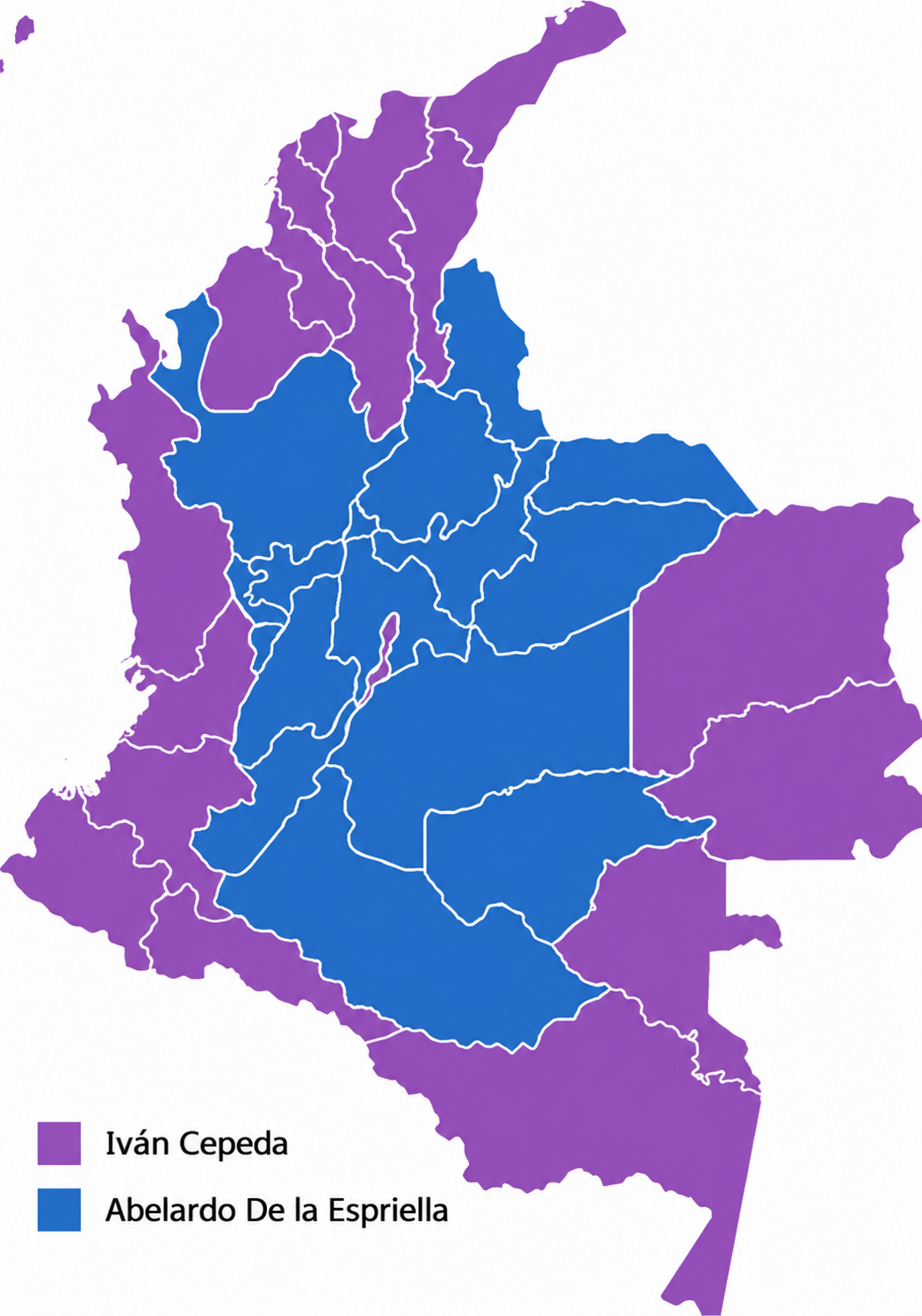
Colombia 2026 1st round top two (Graphic: Sofi Imfeld for Finance Colombia)
Then there is the absence of a track record. He has never held any office, so there is nothing to go on. Does he become a statesman or a caudillo wannabe? We do not know, and that uncertainty is itself a cost. Finally, the persona. His public identity strikes me as a bit of a gomelo — Colombian slang for a stuck-up rich kid. People often cultivate a public character that has little to do with who they really are, so perhaps the private Abelardo is a prince. But he is asking voters to choose the public one, and the public one rubs me the wrong way.
The case for Iván Cepeda
Now the honest case for Cepeda. He will very likely put real attention on the marginalized and the forgotten parts of the country, and the map backs this up: in the first round he carried the entire Pacific coast, the forested borders with Ecuador, Peru, and Brazil, and most of the Atlantic provinces — the exception being Antioquia, whose population concentrates far to the south around Medellín. Much of that Atlantic coast, outside Barranquilla and the touristy parts of Cartagena, has suffered generations of corruption and chronic underinvestment. Someone paying attention to those places is not a bad thing.
He is consistent and predictable. He has a long career and a coherent, stable ideology. I may disagree with that ideology — you will hear about it in the cons — but no one can call the man unpredictable. You know what you are getting, and in politics that is worth something.
He would try to actually implement Santos’s 2016 peace accords. The pact has real flaws and lacked genuine commitment from the current and previous administrations, but it did demobilize thousands of fighters who are no longer in the bush kidnapping and bombing people. Pushing to finish that work honestly has value.
And to be fair, he is clearly more competent than the ally currently in office. He is more intelligent and more disciplined than Gustavo Petro. Consider how Petro has governed: unable to push through much of his agenda, running the Casa de Nariño like a reality show, cycling more than sixty ministers through nineteen ministries in under four years. How do you accomplish anything while swapping in a new minister roughly every three weeks? I do not think a Cepeda administration would bring the same chaos and palace intrigue. And he would command the largest bloc of support in Congress, so he would be more effective at moving his agenda; he knows how the machinery works. Credit where it is due — he does not stand up in cabinet meetings inventing his own physics. That is a low bar, but Petro keeps walking under it and Cepeda clears it.
Finally, he has a real, lifelong commitment to the victims of violence in Colombia. Whatever else you say about him, that commitment is genuine and it is the through-line of his entire life. That counts.
The case against Iván Cepeda
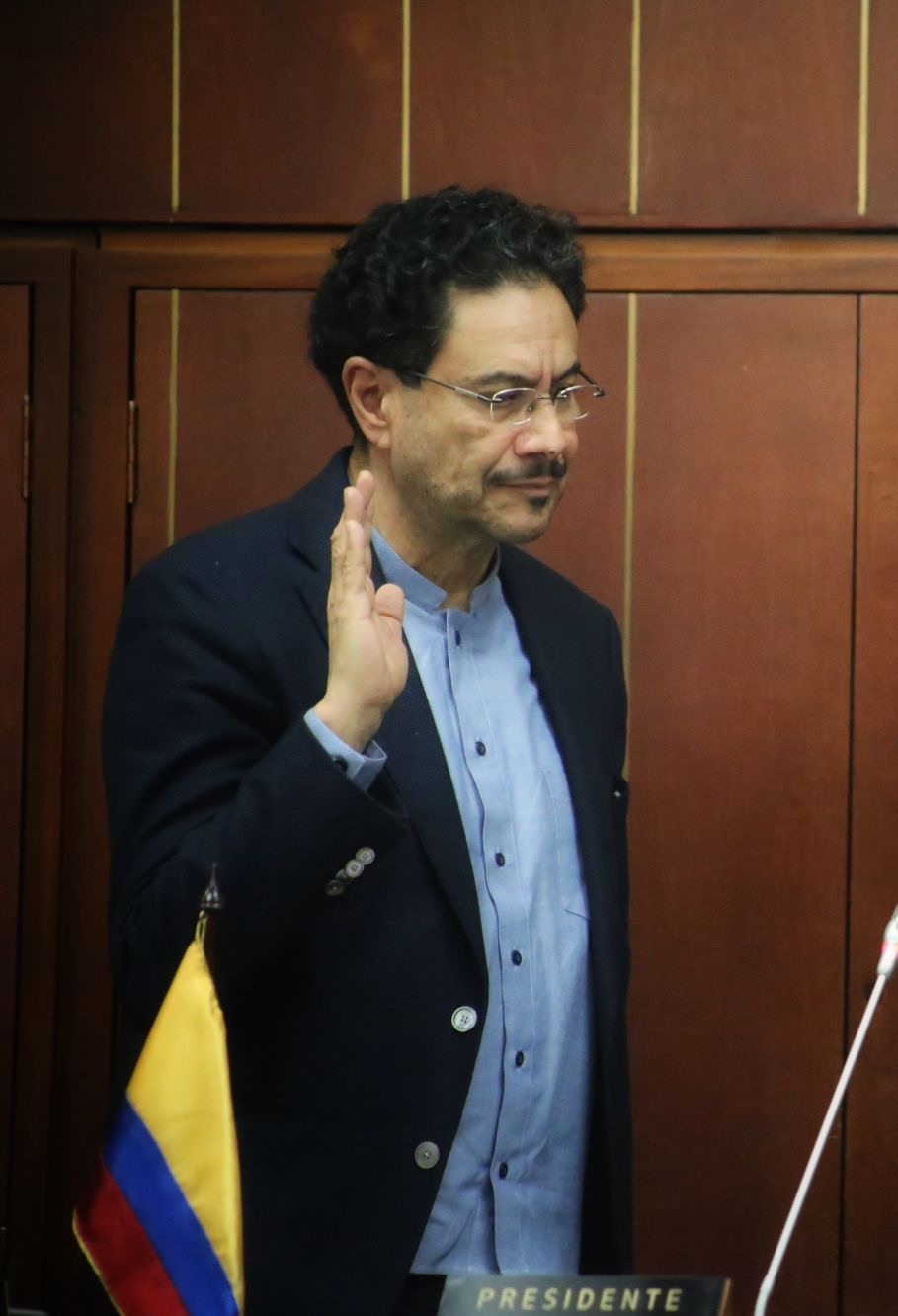
Iván Cepeda is a senator, former member of the Communist Youth, educated in Bulgaria during the Soviet era, and key player in the negotiation with armed guerilla groups. (photo: Colombian Senate)
And there are many cons. The first is the mirror I opened with: he has shady friends too. He was close to the Chavista senator Piedad Córdoba. Just as de la Espriella calls his contacts with Boliche purely professional, Cepeda says his ties to the FARC commander Raúl Reyes were purely those of a peace negotiator. But Cepeda went further. When the FARC commander Jesús Santrich was locked up and ready to be extradited to the United States on drug-trafficking charges, Cepeda worked fiercely to get him released from the Fiscalía‘s Bunker. Once out, Santrich fled into Venezuela and restarted the Segunda Marquetalia, a FARC dissident network. And here is the part that lands like a gut punch a year later: that same Segunda Marquetalia is the group Colombian prosecutors have now linked to the assassination of presidential candidate and senator Miguel Uribe Turbay, who was shot in Bogotá in June 2025 and died that August. I want to be careful and fair — that is an attribution by the Fiscalía, and serious analysts at InSight Crime have noted the public evidence is thin, so it should not be treated as settled fact. But the chain — Cepeda helps free Santrich, Santrich restarts the Segunda Marquetalia, the Segunda Marquetalia is tied to a magnicidio — is a heavy thing to carry into a presidential race.
Second, he is soft on the guerrillas, broadly. He has a proven record of leniency toward the FARC, the ELN, and armed groups generally, and he is an architect of Petro’s failed Total Peace. Under that nurturing approach those groups have flourished, and I think they would keep flourishing under a Cepeda administration. He seems to see them more as victims of state violence than as the kidnappers, narcotraffickers, extortionists, and terrorists that they are. La Silla Vacía’s own reporting — and they are not a right-wing outlet — concluded that Cepeda bears real political responsibility for the failure of Total Peace, having pushed a negotiation model that was too ambitious, legally ambiguous, and weak before armed groups. When the violence comes from the state, Cepeda sees structure and systemic responsibility; when it comes from the guerrillas, he tends to see context and a chance for peace. That blind spot defines him.

Former 2022 presidential candidate Rodolfo Hernandez (photo: candidate’s website)
Third is his health and his running mate, which is delicate but real. Cepeda has had cancer twice. The late Rodolfo Hernández, who lost to Petro in 2022, died in 2024 of cancer after also having had liver and colon cancer, so the risk is not hypothetical. If Cepeda did not finish his term, Aida Quilcué would take over, and her career — as an indigenous Nasa leader, minga organizer, and senator — has centered on those issues rather than monetary policy, foreign affairs, or national security, which makes her approach to them a genuine unknown. People also doubted Francia Márquez, and she turned out to be the articulate, level-headed one beside Petro’s wilder talk, so I will say nothing against Quilcué as a person. But a possible succession to a medically fragile president is an inarguable risk, and it would be foolish to pretend otherwise.
Fourth, I cannot imagine investor confidence improving under a Cepeda presidency. A data point worth chewing on: the peso is currently strong. Part of that is the dollar’s broad global weakness, but part of it, in my read, is the market reacting to the strong polling of Cepeda’s opponent. Markets vote too, and they are nervous about the left.
Fifth, the father — and I want to be fair here. You cannot reliably judge a son by his father; my own father was a politician, and as an adult I spent most of my life in the party opposite his, with a great relationship and very different philosophies. So I will not convict Iván Cepeda for his father’s beliefs. The difference is that Cepeda does seem broadly aligned with them. His father was secretary general of the Colombian Communist Party, Iván studied in Soviet Bulgaria, and though he says he grew disillusioned with the hypocrisy of Soviet communism, he still appears committed to a far-left ideology. If that is your cup of tea, count it a plus; I have never been fond of Marx or Engels.
Sixth is crop substitution, and this one deserves a direct conversation. On paper it sounds marvelous: rather than spray coca with herbicides that wreck the environment and people’s health, offer farmers a legal alternative and a path out. If it worked the way it is drawn up, I would back it one hundred percent. The problem is the gap between the brochure and the dirt road — and that gap is built on a premise that simply is not true on the ground: the premise that the campesino is a free actor who chooses to grow coca and could, if persuaded, choose to grow something else.
In much of rural Colombia, the small farmer does not get to volunteer. Where the FARC dissidents and the ELN hold territory, the armed group tells the farmer he will cultivate coca, do the manual labor of harvesting it, and sell the leaf or paste to the group at a price the group sets — under penalty of death. Refuse, and the farmer is driven off his land or simply killed. This is not a lifestyle preference; it is coercion at gunpoint. The reporting bears out the broader pattern. Finance Colombia’s coverage, drawn from InSight Crime, documents how the power vacuum left by the FARC’s 2016 demobilization was filled by the ELN, the Gaitanista Self-Defense Forces, and FARC dissidents fighting for control of coca zones, and how the state’s failure to deliver on substitution let armed groups fill the vacuum and tighten their grip. The human cost is staggering: after families signed substitution agreements, the murder rate of supportive social leaders rose by 546 percent, according to a study cited by InSight Crime, and only about 5 percent of the program’s 2023 budget was actually executed. You cannot ask a farmer to switch crops when the entity controlling his life and his land is not the government but a guerrilla faction that has already told him what he will plant.
That is why this is not a matter of asking farmers nicely to grow coffee or cacao. It is not their choice. Security has to come first. Crop substitution can only work where the state — not the guerrillas — holds the territory and can guarantee a farmer’s safety when he says no to coca. The armed groups must be displaced before substitution has any chance, and any candidate who treats substitution as a soft alternative to security has the sequence backwards. That is the simple truth of it, and it is the heart of my concern with the Total Peace approach Cepeda helped design.
Seventh, he wants to expand the state’s role across the board, including continuing Petro’s effort to take over the health sector. Before the pandemic, Colombia had one of the best reputations in the world for health-care quality. Is it unequal? Yes — care in an isolated hamlet does not match Cali or Medellín, and the south of Bogotá does not match the north. Then let the government build clinics and hospitals where they are missing. There is no reason to take over the parts of the private system that work in order to do that, unless one objects on ideology to doctors and dentists existing as small businesspeople. That is ideology, not health policy.
Eighth, if Cepeda wins he may well protect Daniel Quintero, the former mayor of Medellín under indictment on more than forty counts of corruption. That kind of debt-collection worries me. And ninth, the selective conscience. Cepeda is a former member of the Communist Youth — a plus if you are a communist, unsettling if you are not. The FARC and ELN are also communist groups; one wonders whether that is the root of his apparent sympathy. He casts himself as a human rights defender yet stays conspicuously silent on the abuses of the Chavista regime in Venezuela. La Silla Vacía documented this in detail: roughly a decade of avoiding criticism of Maduro’s repression, fraudulent elections, and alliances with Colombian guerrillas. Cepeda notices human rights violations committed by people he dislikes while exempting bad actors he is closer to, provided they are communist or socialist. The record on that is fairly clear.
So where does that leave us?
Two men. One built his life on being seen — a brilliant, theatrical defense lawyer for the powerful and the accused, now promising an iron fist while surrounding himself with at least one genuinely serious technocrat in José Manuel Restrepo. The other built his life on a single tragedy — a disciplined, consistent, ideologically committed man of the left who has fought for victims for thirty years, and who carries a blind spot the size of a guerrilla encampment.
Here is the paradox I cannot get past: the “tough on crime” candidate has spent his career defending criminals, and the “human rights” candidate stays silent on half the human rights abuses in his own backyard. Each is, in some way, the very thing he claims to oppose. This is not a runoff between an angel and a devil. It is a runoff between two men who each ask voters to trust that their inconvenient friendships were strictly professional.
I am uneasy about both candidacies, for very different reasons, and I am doing what I said I would: laying it out and handing it to the reader. For deeper background, see Finance Colombia’s earlier survey of how the leading candidates draw divergent maps for foreign capital, security, and the rule of law, its reporting on what is behind Colombia’s increased violence, and its account of the final push of the Total Peace policy. The runoff is Sunday, June 21, and the winner is inaugurated August 7.