
Let me give you some advice for visiting Colombia. Honestly, most of it applies almost anywhere, so I hope you find it useful wherever you travel.
One of the things I love about Colombia is that it is a genuinely polite society. People here aren’t just nice, they’re polite — and usually, even when they’re not feeling nice, they’re still polite. But there are a couple of credit card traps worth knowing about before you go. They aren’t common, and I don’t want to be alarmist, but they do happen, especially in tourist-trap areas where the person ringing you up figures they will never have to face you again. Think the tourist zones of Cartagena, the Zona T in Bogotá, or Parque Lleras in Medellín — places with plenty of drinking and carousing.
First, some good news. Colombia is actually ahead of the US on everyday card acceptance: even small shops and restaurants take cards and have tap-to-pay readers. And unlike in the US, where a server often disappears into the back with your card, here they bring the reader to your table, or you step up to the counter where the machine is. You rarely lose sight of your card, which is more secure. But here are the two scams.
Scam No. 1: the wrong amount entered on the reader. This one is on the merchant. They punch in some random, inflated amount — not your actual bill — and count on you tapping your card without glancing at the screen. Making it worse, many machines in Colombia don’t print a paper voucher. In my experience the Home Center hardware chain and the Jumbo grocery chain are both notorious for that. I’m not accusing them of anything shady — I shop at both — but I like a printed voucher so I can confirm everything matches what we agreed.
“Before you tap, make sure the amount on the reader is correct. Politely ask to verify it. That’s all.” — Loren Moss, Finance Colombia
If you’re charged the wrong amount, your only recourse is to go back and chase it down once you notice, which might be the next day. By then the same staff may not be working, or the place may still be closed from the night before. This matters even more with a debit card than a credit card: with debit you don’t have the same protections, and once the money leaves your account it can be very hard, or impossible, to get back.
The fix is simple. Before you tap, make sure the amount on the reader is correct. If they try to take the card from your hand, politely ask them to show you the amount they entered first. That’s all it takes.
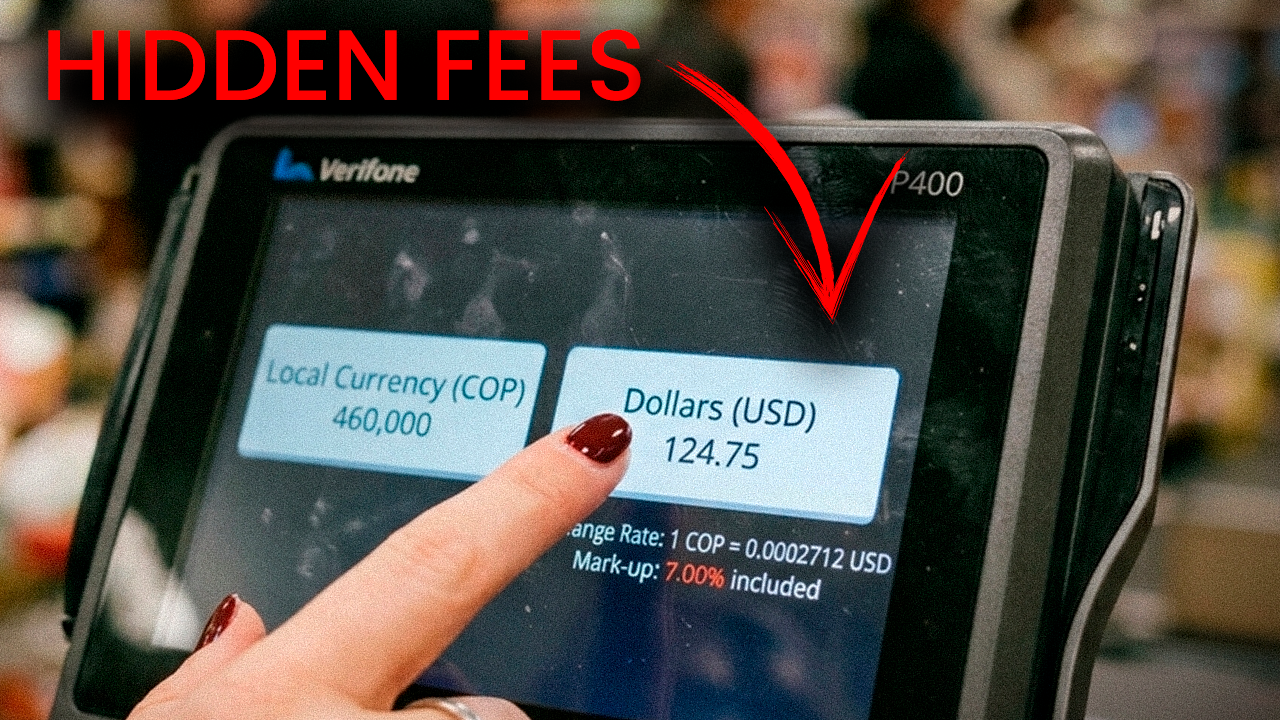
Scam No. 2: dynamic currency conversion. This one really gets under my skin, and it’s run by the card networks and ATM operators, not the shop. At the register or the cash machine, they “kindly” offer you a choice — pay or withdraw in Colombian pesos, or in your home currency, such as US dollars or euros. Choose your home currency and they hit you with a lousy exchange rate plus a commission, usually around 7%. It’s right there on the screen. You’re paying roughly 7% for absolutely nothing. The industry calls this dynamic currency conversion, and you should always decline it.
The numbers add up fast. Pull $2 million COP out of an ATM — roughly $550 USD right now — and selecting dollars can cost you up to $60 USD extra. That’s $60 USD handed over for free. Always choose to be charged in pesos, the local currency.
Here’s the nuance: that money goes to the banks, not to the cashier or the ATM attendant, so don’t take it out on the person in front of you. Many readers don’t even offer the trick and simply charge in pesos — the gas station in my neighborhood is like that, and I love it. But when the option does come up, the reader literally flashes a message telling the clerk to “hand the machine to the customer.” A lot of them ignore it because they’re rushing, cycle through, and hit “dollars” without asking. So always check your voucher and confirm they didn’t.
This has happened to me at least three times. Once, at a Papa John’s (NASDAQ: PZZA), the cashier was hammering the buttons. “Cóbrame en pesos,” I told him, firmly, because he didn’t look like he was paying attention. He ignored me and charged the dollar rate anyway. I insisted he reverse it. He didn’t know how and didn’t have the authorization, so he had to call his manager for the codes. It took 20 minutes while the carry-out line backed up — but that was his mistake, not mine.
Another time, at a mini-Carulla in Bogotá — Carulla is a nice grocery chain — the cashier never even asked and charged me in dollars. Same drill: I made him reverse it. He had to wake his manager up by phone, because he had neither the authority nor the know-how. That one took 40 minutes. He tried to send me back the next day; absolutely not — your mistake, you fix it now. He swore the machine never asked about pesos or dollars, so after he voided the charge, we ran it again slowly, step by step. Sure enough, right there on the screen: “dollars or pesos?” He’d simply ignored it. He learned something that day, the hard way. Stand up for your rights.
A related tip: if you travel internationally, don’t use a card that charges foreign transaction fees. There’s no good excuse for it. Bank of America (NYSE: BAC), for instance, charges them on its debit cards unless you carry a very high balance, so I don’t use them abroad. For debit, I like the Charles Schwab (NYSE: SCHW) checking account card, but there are others — your credit union may offer a good deal, and credit unions exist worldwide (in Colombia they’re called cooperativas). For credit, I use the JPMorgan Chase (NYSE: JPM) Sapphire Reserve: strong travel benefits and, crucial for me, no foreign transaction fee. If you don’t need the premium perks, the Sapphire Preferred is a solid travel card too. Nobody pays me to say this, and they are not a sponsor — these are just cards I use personally. If you use my referral link, I might earn a few airline miles as a thank-you.
Has anything like this happened to you? What’s the worst rip-off you’ve run into while traveling? I once wrote about a literal tourist trap in Medellín — a bar in Parque Lleras that was kidnapping and extorting foreign tourists, slapping absurd tabs like $500 USD on a few drinks and refusing to let people leave until they paid. They finally got busted. Tell me your stories in the comments, on YouTube or on our channels on Facebook, LinkedIn, and Instagram.
One last thing. Beyond the usual “like and subscribe” — which does tell the platform you want more of this — I’d ask you not to trust the algorithm. Some ornery politician, whether it’s Uribe or Petro here in Colombia, or Donald Trump or Xi Jinping, could get annoyed and pull strings to get a creator de-platformed. You’ve surely seen it happen, where a YouTuber or podcaster simply vanishes. So please also subscribe to our newsletter; the link is below. I’ll never share your email — we’ve been in business for over a decade, and we never have and never will. For Finance Colombia, just go to FCSubscribe.com.
I’m Loren Moss, publisher of Finance Colombia. Thank you, and be kind, be safe, and stay smart.