
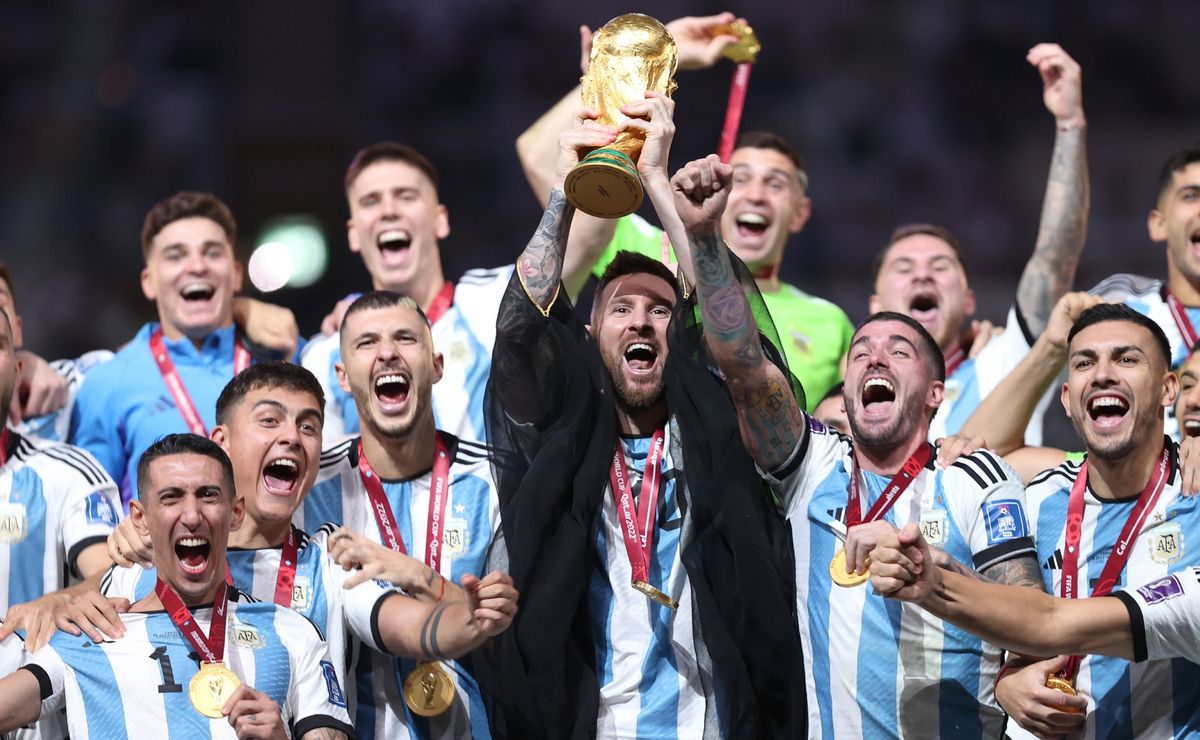
Lionel Messi heads to his sixth World Cup with Argentina carrying a responsibility he has never faced before: defending the title. In a notable footnote, the squad announced by Lionel Scaloni features more returning outfield players from a World Cup-winning roster than any other defending champion this century, raising the question of whether holding that experienced core is an asset or a liability heading into the tournament in Mexico, Canada and the United States.
According to a stat surfaced by Telemundo journalist Jaime Macias, Argentina has retained more outfield players from their 2022 championship squad than any other World Cup-winning nation since the turn of the century. Of the players who lifted the trophy in Qatar, 15 have been called up for the 2026 title defense, with the remaining 11 spots going to players who have yet to win a World Cup gold medal.
It is worth noting that the expanded 26-man roster format, introduced for the 2022 edition, means the pool of potential returnees was already larger than in any previous cycle, naturally inflating the number of champions available to be recalled.
Add as a preferredsource on Google
Excluding goalkeepers Emiliano “Dibu” Martinez and Geronimo Rulli, the outfield players who lifted the World Cup in 2022 and have been named in Argentina’s 2026 squad are: Nicolas Tagliafico, Gonzalo Montiel, Lisandro Martinez, Cristian Romero, Nicolas Otamendi, Nahuel Molina, Leandro Paredes, Rodrigo De Paul, Exequiel Palacios, Alexis Mac Allister, Enzo Fernandez, Julian Alvarez, Lionel Messi, Lautaro Martinez and Thiago Almada.
Tweet placeholder
At first glance, bringing back the core of a World Cup-winning squad would seem like the most logical strategy for a defending champion. The historical record this century, however, tells a more cautionary tale: the more World Cup winners a defending nation has recycled into the following squad, the worse their results have tended to be.

see also
Julian Alvarez reportedly undergoes special regenerative treatment in Argentina to recover from injury ahead of 2026 World Cup
Spain brought 14 returning outfield players to the 2014 World Cup after winning their first title in 2010 and suffered a humiliating group-stage exit. France carried 13 outfield survivors from their 1998 triumph into the 2002 edition and similarly failed to survive the group stage with just one point.
Italy and Germany followed the same cursed pattern. The Azzurri brought back eight players from their 2006 title-winning squad and crashed out in the first round in 2010, while Germany suffered the same early exit in 2018 with eight returnees from their 2014 champion group.
Brazil, with eight survivors from their 2002 squad heading into 2006, managed to escape the group stage but still fell short of expectations, bowing out in the quarterfinals despite boasting a generation of stars that included Ronaldinho, Ronaldo Nazário and Adriano.
The most successful transformation of a defending champion came from Didier Deschamps’ France. Going into the 2022 World Cup, he brought just seven survivors from the 2018 championship squad, namely Benjamin Pavard, Raphael Varane, Lucas Hernandez, Antoine Griezmann, Olivier Giroud, Kylian Mbappe and Ousmane Dembele, and reached the final, where they were beaten by Argentina.
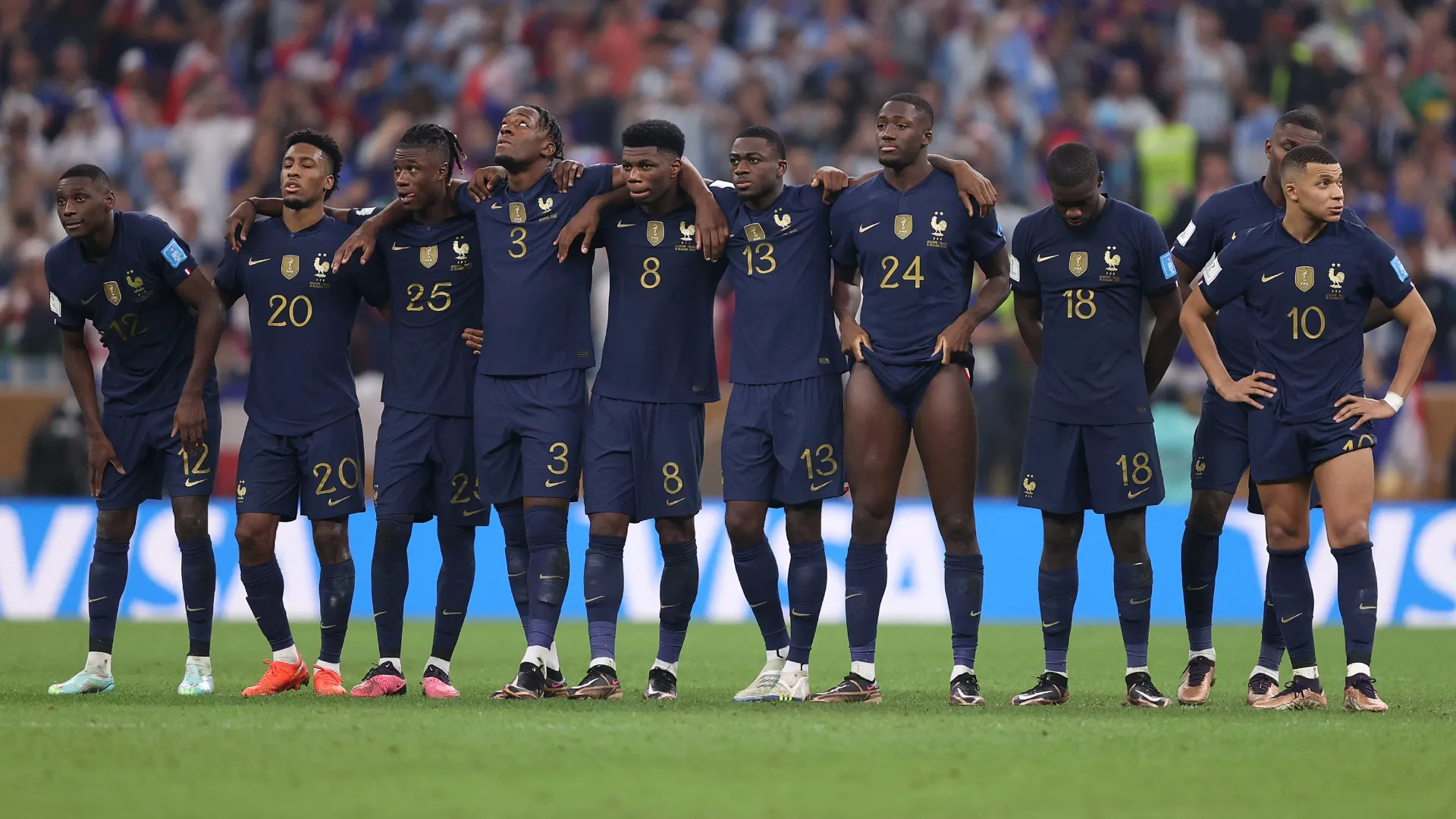
France players react in the penalty shoot out of the FIFA World Cup 2022 Final against Argentina.
If the century’s trend holds, Argentina’s unusually high rate of retention would be a warning sign. And yet the 2026 format itself provides a safety net the previous defending champions did not have, with the expanded 48-team field and a second chance for the eight best third-place finishers making an outright group-stage elimination considerably harder to achieve.
Arriving as back-to-back Copa America champions in 2021 and 2024, winners of the 2022 Finalissima and reigning World Cup holders, Argentina head into the tournament in commanding form. Their CONMEBOL qualifying campaign produced 38 points, the second-best total in their history, trailing only the 43 registered ahead of the 2002 World Cup.
see also
2026 World Cup historic scheduling twist could give Guillermo Ochoa edge over Lionel Messi and Cristiano Ronaldo
One area worth monitoring is the squad’s average age, which sits at 29.1 according to Transfermarkt, making it the oldest of the major contenders. France averages 27, Spain 26.8 and Portugal 28, while Brazil edges Argentina at 29.2. That said, the 2022 World Cup-winning squad also had an average age of 29.1, so experience rather than youth has clearly been a deliberate cornerstone of Scaloni’s approach.
That continuity, however, comes with built-in adaptability. In Qatar, a shocking opening-game loss to Saudi Arabia prompted Scaloni to shake up the lineup, dropping Leandro Paredes, Alejandro Gomez and Lautaro Martinez from the starting eleven and unleashing Enzo Fernandez, Alexis Mac Allister and Julian Alvarez as the young players who seized their moment and never let go.
With those three now established starters rather than emerging talents, Scaloni has also introduced fresh blood to the squad for 2026. The eight outfield additions with no World Cup title are Leonardo Balerdi, Facundo Medina, Valentin Barco, Giuliano Simeone, Nico Paz, Jose Manuel Lopez, Nicolas Gonzalez and Giovani Lo Celso.
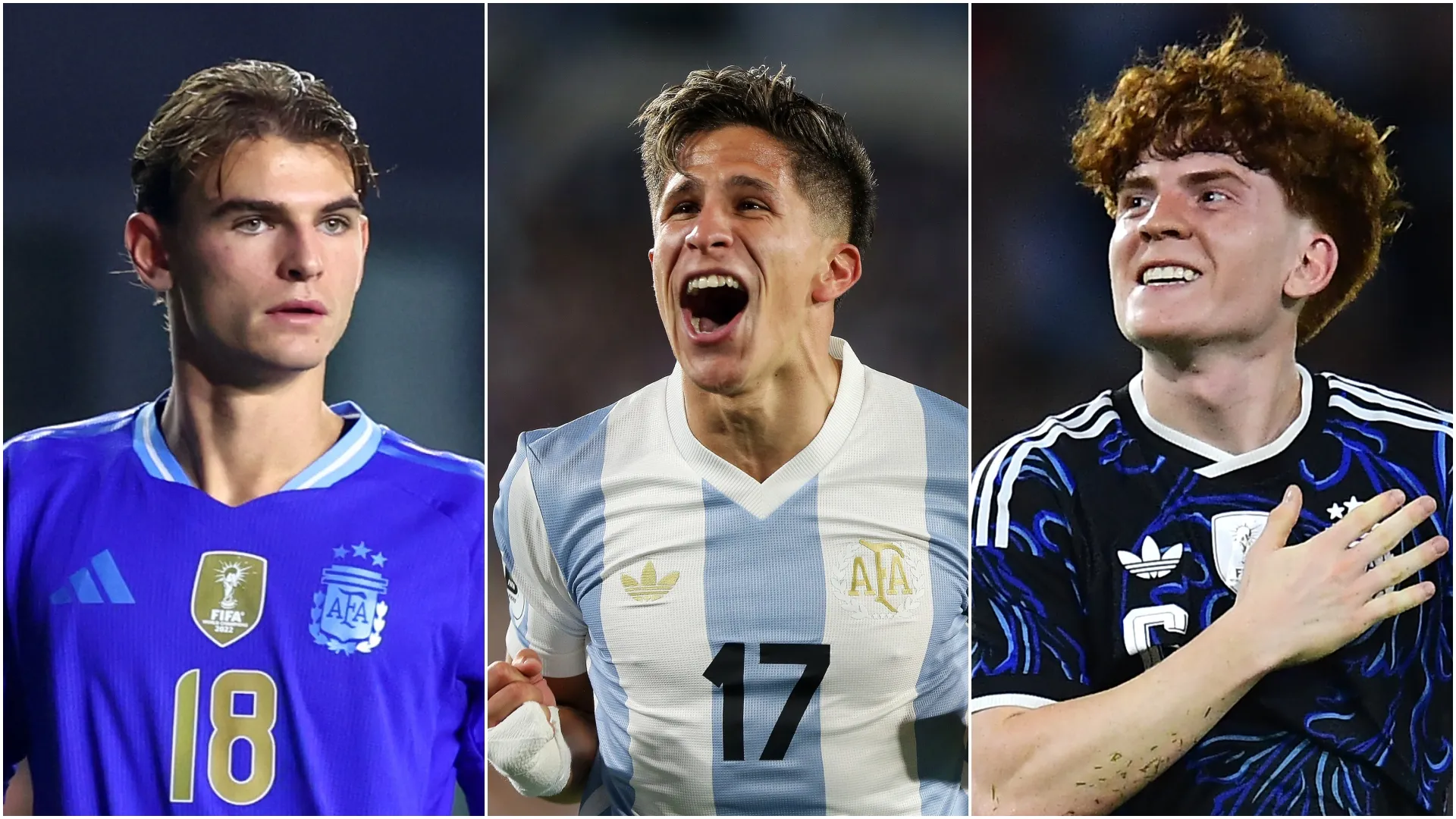
Nico Paz (L), Giuliano Simeone (M), and Valentin Barco (R) of Argentina.
The latter two are not youngsters in the traditional sense, but both were part of Scaloni’s process before injury derailed their 2022 campaigns. The rest, particularly Paz, Barco, Balerdi and Simeone, represent the next generation beginning to push their way into the picture.
The one truly irreplaceable figure from the 2022 starting lineup against France who is absent is Angel Di Maria, whose creative profile has not been directly replicated. Scaloni has adapted by deploying Thiago Almada and Lo Celso in the playmaking role or turning to Nicolas Gonzalez and Giuliano Simeone for more physical, high-energy contributions down the flanks.
Perhaps the most intriguing variable heading into the tournament is psychological. The 2022 squad played with the energy of a team chasing Messi’s last realistic chance at greatness, and that shared sense of mission drove them through every obstacle. With the job done, whether that same hunger endures is an open question, one that the Copa America and the qualifying campaign suggested the answer is yes, but the 2026 World Cup will be the ultimate proof.